

Sogand logo
My StoryCase Studies
Sogand logoSogand

A product designer focused on thoughtful decisions and meaningful experiences.

Available for new opportunities

Navigate

HomeMy StoryWork

Connect

LinkedInEmail Me

© 2026 Sogand. All rights reserved.

Handcrafted in Pixels

Developed bykamycoding
SOGAND
Clinical UXHealthTechUX for Complex Systems

OsifyAI

Child Growth Monitoring Platform

Redesigning a pediatric bone-age analyzer into a multi-role clinical workspace, built around how visits actually happen.

OsifyAI logo
Total patients
+1.4%
1,404

1.4% increase compared to last month

Patients today
+8.4%
27

8.4% increase compared to yesterday

Patients this month
+12.3%
248

12.3% increase compared to last month

Patients last month
-3.2%
221

3.2% decrease compared to the previous month

Patients Trend Overview

Patients with normal growth
Patients with abnormal growth
Short stature patients
OsifyAI logo

Specific Medical History

Down SyndromeAsthma

Reference Charts

MPH range Visits

Bone Age Change

Bone age
OsifyAI logo

My Colleagues

Saturday, August 24, 2024
Mohammad Amin Abbasi
Doctor's Assistant
Contact:09171234567
Joined:May 4, 2025
Soheil Ramazani
Soheil Ramazani
Doctor's Assistant
Contact:09171234567
Joined:May 4, 2025
Mobina Hosseinzadeh
Mobina Hosseinzadeh
Secretary
Contact:09171234567
Joined:May 4, 2025
OsifyAI logo

Patients · Month trend

Visits across the selected period

Height Velocity distribution

Average HV: 5.4 cm/year

Normal64%
Below expected22%
Above expected14%

Patients by age group & gender

Distribution across pediatric age bands · Month

BMI trend

Patient share by BMI category · Month

Product context

OsifyAI began as an MVP focused on one task: estimating bone age from hand X-rays.

The goal was to support pediatricians in growth assessment. A critical part of diagnosing developmental conditions.

I joined to help evolve it into a system that could support the full visit, not just one moment of it.

Role
Product Designer
Timeline
11 months
Team
3 designers · PM · Engineers · Pediatric endocrinologist
Product Snapshot

Patients Trend Overview

Patients with normal growth
Patients with abnormal growth
Short stature patients

Patient Metrics

Last 71 days

Height

+1.4 cm
0cm

Height SDS

+2.95
0.00SDS

Weight

+1.4 kg
0kg

Weight SDS

+1.35
0.00SDS
The problem I had to solve

The AI worked. The workflow didn't.

  • OsifyAI could read a hand X-ray in seconds. But a real visit needs more: birth history, medications, past visits, growth charts.
  • These existed, but not as a connected workflow.
  • Doctors had the AI's output. Everything else was fragmented across paper, memory, and separate tools.
  • And the system was designed for a single user. Clinics don't work that way.
Process

Insight from doctor interviews

A visit happens in stages, not on one screen.

Doctors described growth assessment as a process: understanding context, capturing measurements, reviewing patterns, and making a decision.

This showed that OsifyAI had to support the full journey — from context to diagnosis.

01

Intake

Understanding the patient before anything else: history, conditions, medications, and family context shape every decision.

02

Measurement

Capturing the current state: height, weight, and X-ray as inputs to the visit.

03

Analysis

Evaluating growth over time: comparing against standards and previous visits, not just a single value.

04

Decision

Diagnosis is the outcome: where clinical judgment, not AI alone, determines the next step.

The product had to support multiple roles

Doctors, assistants, and clinic admins contribute in different ways. That meant the product architecture had to support different responsibilities, access levels, and moments in the workflow.

Doctor

Clinical Lead

Doctor

Reviews patient history, interprets bone age results, writes prescriptions, and makes the final diagnosis.

Assistant

Data Entry

Assistant

Captures measurements, uploads X-rays, manages visit scheduling, and prepares data before the doctor review.

Clinic Admin

Management

Clinic Admin

Oversees team access, monitors activity across the clinic, and manages subscriptions and settings.

This led to a workspace-based access model

One person could work across multiple clinics, with different responsibilities in each.

Static, global roles broke in this context.

So I introduced a workspace-based model, where access and responsibilities are defined per workspace, not per user.

Before

Role-based permissions

Doctor

Owner

(global)

Member

(global)

Which one applies where? The same role everywhere.

After

Workspace-based permissions

Doctor

Clinic A

Private practice

Owner

Clinic B

Multi-specialist

Member

One identity. Role defined inside each workspace.

Insight from doctor interviews

A visit happens in stages, not on one screen.

Doctors described growth assessment as a process: understanding context, capturing measurements, reviewing patterns, and making a decision.

This showed that OsifyAI had to support the full journey — from context to diagnosis.

01

Intake

Understanding the patient before anything else: history, conditions, medications, and family context shape every decision.

02

Measurement

Capturing the current state: height, weight, and X-ray as inputs to the visit.

03

Analysis

Evaluating growth over time: comparing against standards and previous visits, not just a single value.

04

Decision

Diagnosis is the outcome: where clinical judgment, not AI alone, determines the next step.

Final Design

Doctor Dashboard

Create or switch workspaces

Impact

Directional findings from 5 medical-user tests.

Faster access to patient context

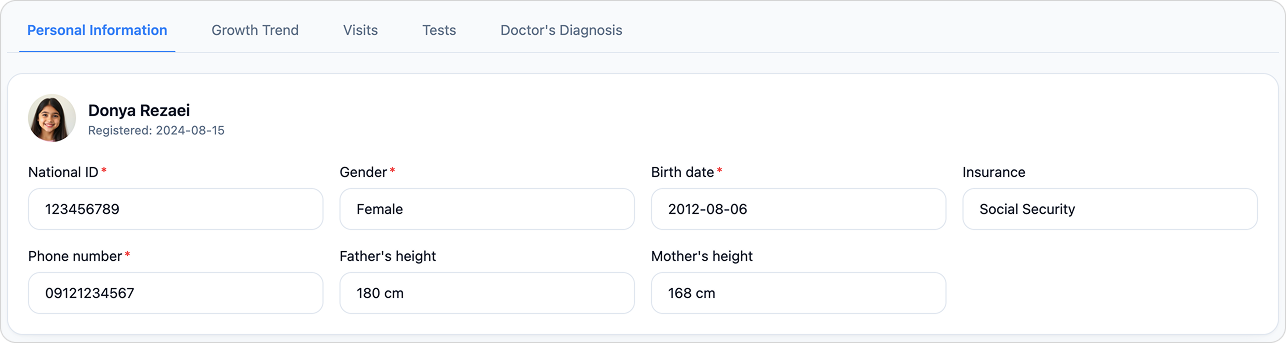
Doctors had to scan one long page to find growth data, history, and visits. I reorganized the record into scoped tabs so key patient context surfaced where doctors expected it.

Time-on-task
2m 10s
0s
Patient profile and context interface

Faster visit documentation

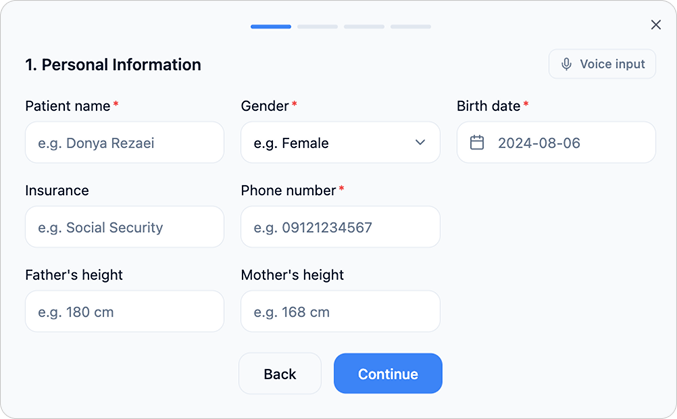
Assistants needed to document visits while the consultation was still happening. I simplified the flow around required inputs and added voice input for longer clinical notes.

Task completion time
3m 20s
0m 45s
Workspace navigation and task switching view

Recognized outputs were editable

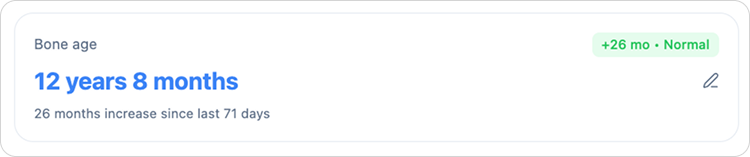
Doctors didn't always recognize AI and lab outputs as editable. I added clear edit affordances so system-generated results stayed reviewable before diagnosis.

Feature discoverability
1 of 5
0 of 5
First impact comparison screen
Second impact comparison screen

Completed diagnosis entry within the visit flow

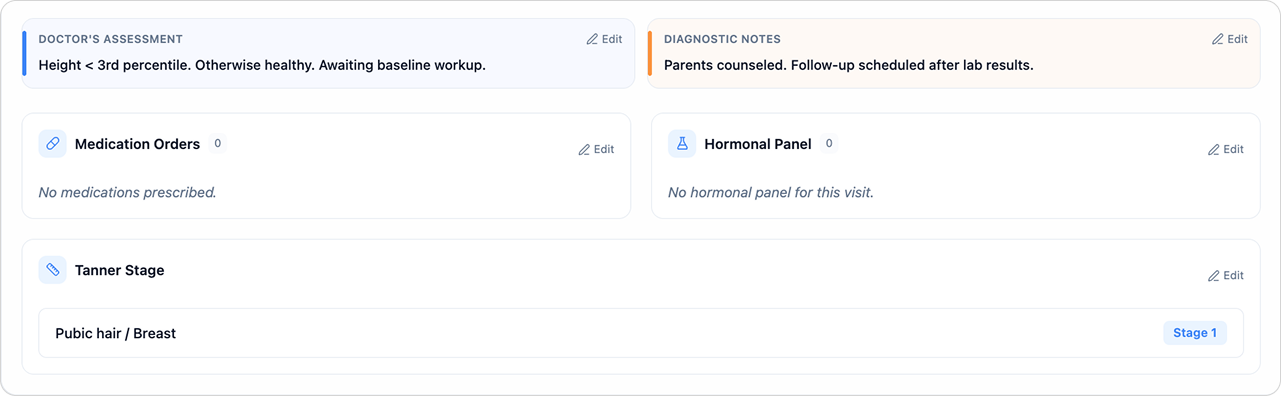
The MVP ended at analysis — visits closed without a clinical conclusion. I introduced a dedicated diagnosis section so doctors could record their final decision within the same visit flow.

New workflow capability
0 of 5
Team management and permission controls

Faster access to patient context

Doctors had to scan one long page to find growth data, history, and visits. I reorganized the record into scoped tabs so key patient context surfaced where doctors expected it.

Time-on-task
2m 10s
0s
Patient profile and context interface
What I learned

01

Designing for healthcare means designing around a system, not a single feature.

02

For OsifyAI, supporting pediatric growth monitoring meant understanding who works inside the clinic, what each role needs, and how a doctor moves from patient context to clinical decision in real life.

03

This project taught me that a strong digital experience starts with deeply understanding the user's working environment, so the product can support daily care, not just display data.