Mooday
Designing Adaptive Daily Planning Based on Energy & Mood
Product design case study exploring how planning can become more human-centered by adapting to energy, mood, and real-life dynamics. Focused on reducing pressure, making invisible work visible, and enabling flexible daily structures.
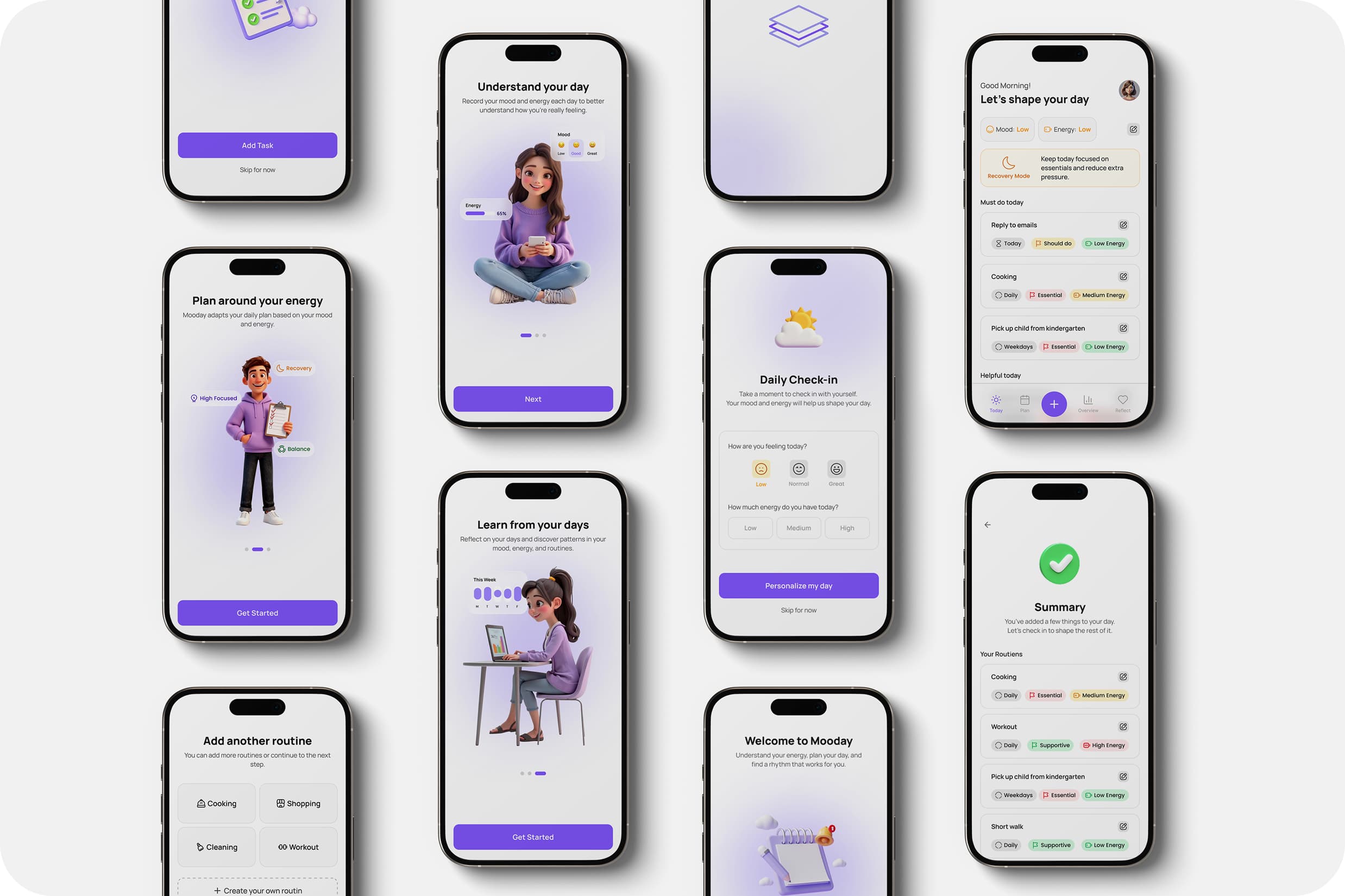
Overview
Introduction
Mooday is a concept for a human-centered planning tool that adapts to users' energy, mood, and daily context. The project was developed over 4 months at Digitale Leute School, focusing on rethinking how daily planning can better reflect real-life dynamics instead of static task lists.
Methods
- User Interviews
- Survey (quantitative insights)
- Persona & Journey Mapping
- Insight Clustering
- Hypothesis Definition
- Iteration & Flow Redesign
- UI Design & Prototyping
Summary
Why do we plan more than we can actually do?
Many people plan their days with good intentions, yet still end up overloading themselves. To understand why this happens, I started by questioning how people estimate their time, energy, and daily capacity.

Invisible work is underestimated
Routines and everyday tasks take more time & energy than expected.
Planning focuses on visible tasks
Important to-dos are prioritized, while routine work is overlooked.
Capacity is misjudged
Time, energy, and actual daily limits are not estimated realistically.
Mismatch creates frustration
Plans don't reflect reality -> leading to stress and a false sense of low productivity.
Early signals from existing conversations
Before conducting interviews, I analyzed online discussions around daily planning, mental load, and productivity. This helped identify recurring patterns in how people perceive their time, energy, and invisible work.

“I'm busy all day, but by the end it feels like I haven't accomplished anything. My to-do list is still almost full, even though I didn't take a break.”

“Many of my tasks don't even appear on my to-do list—planning, organizing, thinking about everything. It takes a lot of energy, but no one really sees it.”

“I often think a task will take just a short time, but then I realize it's made up of many small steps. In the end, everything takes much longer than planned.”
What I learned from talking to users
While my initial assumptions around invisible work and misestimation were confirmed, the interviews revealed a deeper issue: planning doesn’t account for how people actually feel and function throughout the day.

“To-do lists calm me down... they help me clear my mind.”
Planning is used for control, not for realistic decisions
People don’t plan to reflect their actual capacity. They plan to feel organized and avoid forgetting things.
Planning is more about reducing anxiety than managing time.
Interested in working together?
Whether you're building a product, improving an existing experience, or looking for thoughtful UX feedback I'd love to collaborate.

Explore more work
Too Good To Go — Improving Retention Through Personalization
Peria — Smart wellbeing app for women
ChatGPT — Designing a Structured AI Workspace Experience
Heldio — Framing the Real-World Language Performance Gap